
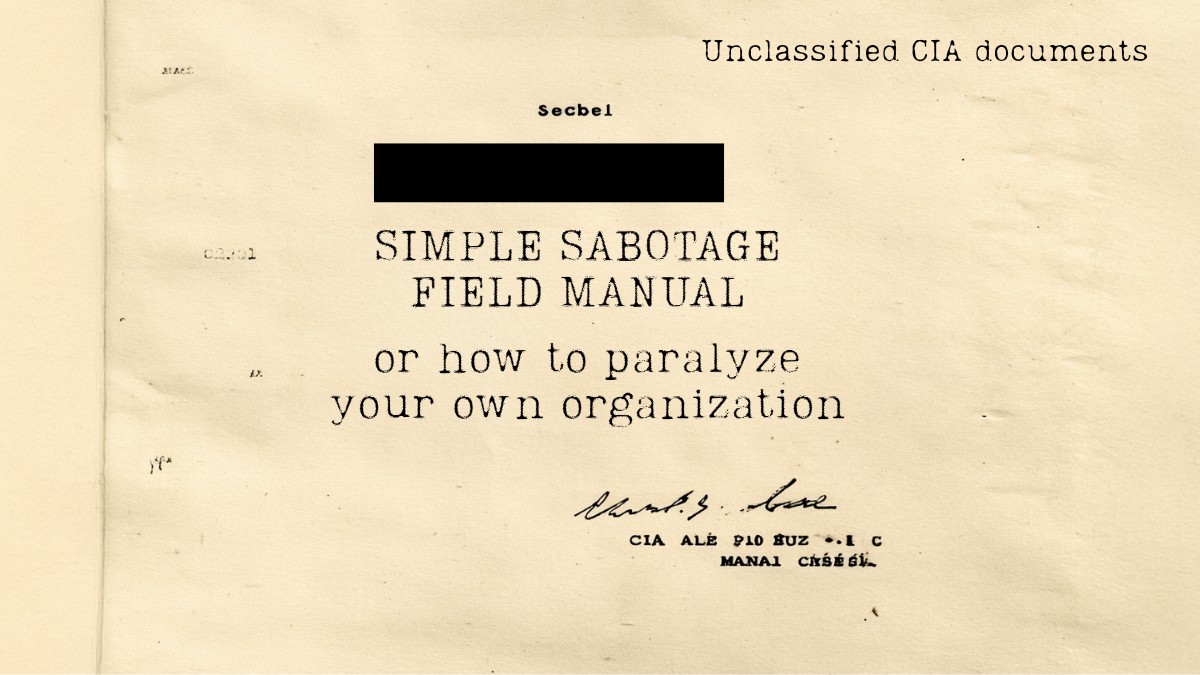
Simple Sabotage Field Manual, or how to paralyze your own organization
The “Simple Sabotage Field Manual” developed by the OSS (CIA) in 1944, discovered only in 2008, shed light on the surprising similarities between wartime sabotage techniques and modern organizational practices. Strategies such as excessive meetings, over-analysis, or procedural bureaucracy, instead of serving goals, often lead to organizational paralysis.
Many individuals act unwittingly, believing that they are contributing positively to the company. Perfectionism, over-analysis, or an excess of procedures are rewarded as traits of responsibility and meticulousness, rather than forms of sabotage. It’s important to recognize that these actions slow down the efficiency of an organization.
To counteract unconscious sabotage, it is recommended to minimize meetings, delegate decisions, and focus on the spirit of the rules, not merely the letter. Key is conscious management, questioning objectives, building trust and accountability, and eliminating unnecessary procedures. Awareness of similarities to sabotage techniques may be key to effective organizational transformation.

How to Enhance Meeting Efficiency… Close Meeting During the Meeting
Business meetings are often viewed negatively by leaders and employees due to time wastage and a lack of concrete results. Traditional meetings usually end with promises but without clear actions, complicating objectives realization and causing confusion. The solution is to shift the approach by ‘closing the meeting during the meeting’,

Talents in Boxes – Do You Really Know Who the Star of Your Team Is?
The 9BOX method is a talent management tool that takes into account current performance and potential for development. By analyzing these two key dimensions, leaders can make better decisions regarding development, promotions, and resource allocation.
Practical applications of 9BOX include succession planning, recruitment optimization, team restructuring, and performance management system

The 10th Team Member Rule
In business, the absence of institutional dissent can lead to downfall, as seen with Kodak, Nokia, or Blackberry. Leaders must understand that critical voices can prevent costly decision-making errors.
Implementing this rule requires the deliberate selection of the right person and the creation of a suitable organizational culture. In businesses

Sales Is a Mindset – Not Just for Salespeople
Working in sales is a state of mind. It’s a job that requires a specific mental attitude. Salespeople are the ‘fighters’ of the business world, who must maintain a positive approach regardless of circumstances. Empathy, patience, and flexibility are traits that distinguish the best salespeople. Resilience to failure and an

What is the “Outperformer Trap” and how to deal with it?
The phenomenon of the ‘Outperformer Trap’ affects talented professionals whose excellence becomes a hindrance in recruitment processes. Companies fear that such employees will quickly become bored, prove too costly, or demotivate the rest of the team. Concerns over disrupting balance and internal pay structures often lead them to prefer ‘safer’

How to Delegate Tasks to People Who Don’t Directly Report to You
Modern organizations increasingly break traditional hierarchical structures, opting for cross-functional projects and collaboration with various entities. Delegating tasks to people outside one’s own structure requires a new approach based on transferring responsibility while maintaining the autonomy of the executor.
It is crucial to focus on the goal, not the method,

Lay Off HR? Simplify…
IBM, the well-known tech giant, endured a painful lesson when implementing artificial intelligence in HR. Automating processes seemed an ideal solution for routine tasks, but it overlooked a crucial element: human relationships. HR work is not just about procedures, but fundamentally about empathy and judgement, which AI cannot provide. IBM

How I Lost a Great Team Member Due to Lack of Feedback
The resignation of a valued employee brought my attention to issues that have long been clear to me but were sidelined by the rush of daily tasks. Formal evaluation systems often replace genuine conversations, leading to employee isolation and lack of motivation. The pressure for results focuses us on strategic