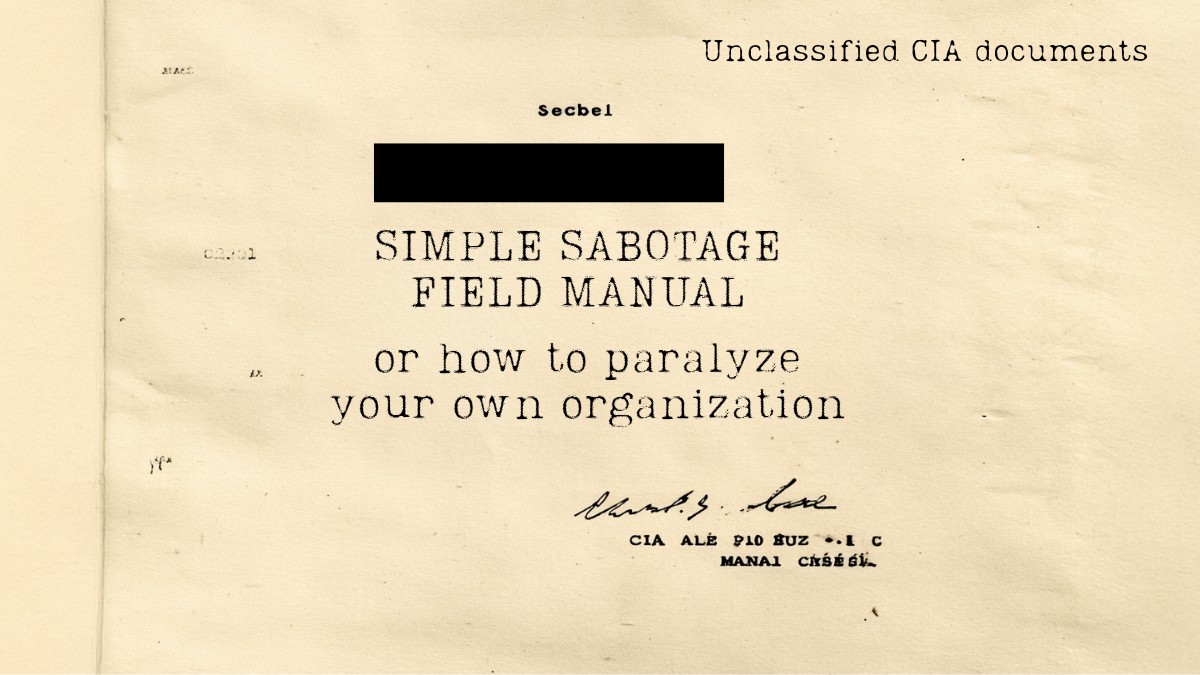
In 1944, as World War II was reaching its climax, the American Office of Strategic Services (OSS, the precursor to the CIA) developed a fascinating document: the “Simple Sabotage Field Manual.” This secret manual contained instructions for civilians in occupied territories on how to effectively paralyze enemy administration and industry through simple, everyday actions. Interestingly, this document was only declassified in 2008, revealing an astonishing truth: many of the sabotage techniques it recommended strikingly resemble… contemporary organizational practices.
When I first came across this document, a chill ran down my spine. Not because it described acts of sabotage, but because I recognized the very same phenomena that I observe in many companies as “standard procedures” or “best management practices.” What was designed as a weapon against the enemy is unknowingly adopted in our organizations’ daily functioning. This historical document thus becomes a paradoxical mirror in which we can see how we unknowingly sabotage our own companies.
The Office Sabotage Manual – Everyday Life in a Corporation
The CIA recommended specific strategies to its secret agents. Here are a few that sound eerily familiar: “Hold as many meetings as possible,” “Discuss matters at length over the least important points,” “Insist that each decision be approved by supervisors,” “Interpret regulations literally.” Doesn’t that sound like a typical day in the average company? The document also advised: “Delay decision-making by requesting more data, reviews, and consultations.”
The modern-day equivalents of these techniques are striking. Executive teams in corporations engage in marathon meetings where the longest discussions revolve around the least strategic issues. Marketing department employees spend days perfecting a single slide in a presentation. Mid-level managers require multiple approvals for routine decisions. All these behaviors, though driven by good intentions, lead to organizational paralysis.
Unaware Saboteurs Among Us
What’s most concerning is that, unlike deliberate saboteurs from wartime, contemporary “organizational insurgents” act with full conviction that they are doing something good for the company. A perfectionist who delays a project by two weeks to fine-tune trivial details believes in their value to the organization. A manager creating a five-step approval process for every decision thinks they are mitigating risk. An employee documenting every step in a complicated procedure assumes they are providing clarity.
This phenomenon of “well-intentioned sabotage” is notably difficult to eliminate because its performers are convinced of its righteousness. Moreover, organizations often reward these behaviors, perceiving them as signs of diligence, quality care, or responsibility. In this way, we inadvertently promote a culture that was designed in 1944 to destroy enemy efficiency.
Organizational Pitfalls That Paralyze Us
Three areas particularly prone to “sabotage practices” deserve further analysis. The first is the cult of meetings. The CIA advised: “Whenever possible, convene committees to consider important matters. Ensure these committees are as large as possible.” Modern companies often follow this strategy, organizing meetings with dozens of participants, most of whom have no real input but all feel obligated to speak up to justify their presence.
The second pitfall is decision-making paralysis stemming from excessive analysis. “Require written reports, check every detail, demand perfection in trivial matters”—these are saboteur recommendations that we now observe as “diligent decision-making processes.” How often does data analysis take longer than implementation? How many projects stall because someone still needs “one more round of feedback”?
The third pitfall is procedural bureaucracy. “Interpret regulations literally, insist on every clause, regardless of circumstances”—this is another strategy from the sabotage manual, which in companies manifests as rigid procedures that no one dares to question, even when they lead to absurd results.
Building a Sabotage-Resistant Organization
The realization that we unknowingly implement techniques designed to paralyze enemy organizations can be sobering. Fortunately, the same document that exposes the problem also points toward a solution. It suffices to reverse the CIA’s recommendations to create an antidote to organizational paralysis.
Instead of maximizing meeting numbers, minimize them. At Toyota, the rule is that a meeting should last as long as necessary, not a minute longer, and involve only those who need to participate. Instead of lengthy discussions about trivial details, introduce discipline in prioritization. Amazon employs the “two-pizza team” rule, if feeding the team requires more than two pizzas, the team is too large.
Rather than demanding continuous approvals, delegate decisions as low as possible. Netflix has built a culture where employees have tremendous autonomy and responsibility for their decisions. Instead of taking rules literally, focus on their spirit and objective. Ask, “What are we trying to achieve?” instead of “What does the procedure say?”
Diagnosing and Eliminating Hidden Sabotage
How can you tell if your organization has fallen victim to unintentional sabotage? I propose a simple test: Do people in your company spend more time talking about work than doing it? Do process discussions take up more space than conversations about outcomes? Do teams wait for the perfect solution instead of implementing the good enough quickly?
If the answer to any of these questions is “yes,” you’re likely dealing with unconscious sabotage. To eliminate it, start by reviewing decision-making processes in your organization. How many people need to approve a typical decision? How long does it take to move from idea to implementation? Then identify the “bottlenecks” and ask whether they are truly necessary or are remnants from times when the organization operated differently.
Also, foster a culture of questioning the status quo. Encourage people to ask, “Why do we do it this way?” and reward those who find ways to streamline processes without losing their value. Remember, bureaucracy is never an end in itself but a means to an end. If the means become more important than the end, you have a classic case of organizational sabotage.
Conscious Management vs. Unconscious Sabotage
What distinguishes conscious management from the unintentional implementation of sabotage procedures? The key difference lies in continuously questioning the objective. A conscious leader constantly asks, “Is what we’re doing bringing us closer to our goals, or is it moving us away from them?” An unconscious saboteur focuses on the process for the process’s sake, losing sight of the broader context.
Conscious management is based on trust and responsibility, while unconscious sabotage grows from fear and excessive control. A conscious leader knows when perfectionism is necessary and when it is a luxury the organization cannot afford. They also understand that the best decisions rarely occur in crowded conference rooms but often in small teams with a clear mandate to act.
The 1944 CIA document can serve not just as a historical curiosity but as a powerful tool for organizational self-reflection. Next time you find yourself in a seemingly endless meeting or struggling with a bureaucratic procedure that seems to exist only to hinder work, ask yourself: Am I an unconscious continuator of the sabotage tradition from World War II?
The best defense against organizational sabotage is awareness. Now that you know the history of the sabotage manual and its uncanny resemblance to modern management practices, you have a powerful tool to transform your organization. Use it wisely, because the stakes are high: the efficiency of your team, your company’s competitiveness, and ultimately, your own professional success.
Source: “Simple Sabotage Field Manual” – a document from the Office of Strategic Services in 1944, declassified in 2008, available in the CIA archives.